Delta Investment Tracker vs TrackMyStack: Trader Dashboard or Private Net Worth Tracker?
Delta is an eToro-owned trading dashboard with real-time prices and account linking. TrackMyStack is a private net worth tracker for mid-to-long-term investors who want to know if their picks actually beat an index. Honest 2026 comparison.
A Tale of Two Refresh Rates
Open Delta and you get a screen that updates several times a second: candlesticks twitching, prices flashing green and red, a notification telling you that something you own moved 1.4% while you were making coffee.
Open TrackMyStack and you get a number. The same number you saw last week, a little higher or lower, and a chart that asks you whether the last twelve months actually went the way you think they did.
That’s the whole article in one paragraph. Delta is built for people who want to watch their portfolio. TrackMyStack is built for people who want to evaluate it.
Delta — owned by eToro since 2019 — positions itself as the dashboard “the world’s top investors” use to make smarter decisions. It connects to your brokerage, exchange, and wallet accounts, refreshes prices in real time, and pushes notifications when something moves.
TrackMyStack takes the opposite approach: no account linking, no sign-up, and a deliberate bias toward the long view. You enter holdings yourself, prices update for supported assets, and the analytics are built around answering one question — is this strategy actually working over years, not minutes?
Both are solid tools. They are just answering different questions for different investors. Let’s break it down.
Delta Investment Tracker
Delta started as an independent crypto tracker, was acquired by eToro in 2019, and has since grown into a multi-asset dashboard covering stocks, ETFs, crypto, commodities, indices, and forex. It links to brokerages, exchanges, and wallets, layers real-time quotes on top, and adds notifications, insider-trade feeds, and AI-generated commentary on the upper tiers.
It is clearly built for people who check their portfolio more than once a day (and probably more than once an hour).
Delta Features
- Account linking: Connects to a wide range of brokerages, crypto exchanges, and wallets via API. Manual entries supported for unsupported brokers.
- Real-time prices: Auto-refreshing quotes across stocks, crypto, ETFs, commodities, indices, and forex (PRO and PRO+).
- Custom notifications: Price alerts and movement notifications on individual assets.
- Portfolio Insights: A library of analytics modules — four on PRO, all eleven on PRO+. Heavy focus on allocation, risk, and trade-level metrics.
- Asset Analytics: Market-move explanations and insider-trade activity for individual stocks, for the kind of investor who wants to know what an executive sold last Tuesday.
- Gains Reporting: Realized and unrealized gains with cost basis and exportable reports (PRO+).
- Multiple portfolios: Up to 40 assets per portfolio on PRO; unlimited on PRO+.
- Delta AI: AI-generated commentary on holdings (PRO+).
- eToro Club Platinum: PRO+ subscribers get bundled eToro Club Platinum perks, which is a sentence that only fully makes sense if you already trade on eToro.
- Cross-platform: iOS, Android, Windows, Mac, and a web app.
Delta Pricing
- Basic — Free. Up to 10 tracked assets, no real-time quotes, limited insights.
- PRO — $53.88/year. Up to 40 assets per portfolio, unlimited connections, real-time quotes, four insight modules.
- PRO+ — $107.88/year. Unlimited assets and portfolios, all eleven insight modules, gains reporting, Delta AI, eToro Club Platinum (region dependent).
Prices may vary by region. There is no real free tier for serious tracking — once you cross 10 assets, you are on a paid plan.
Delta: Pros and Cons
Pros:
- Genuinely broad brokerage and exchange coverage, including crypto wallets
- Real-time quotes and notifications work well for active traders
- Strong asset universe — stocks, crypto, ETFs, commodities, indices, forex
- Insider-trade and event data is unusual at this price point
- Polished apps across iOS, Android, Windows, Mac, and web
- Backed by eToro, so the company is unlikely to vanish overnight
Cons:
- Account linking requires sharing exchange API keys or brokerage credentials with a third party
- Owned by a brokerage (eToro), which is worth knowing when the app is also recommending what to look at
- Free tier capped at 10 assets — small portfolios outgrow it quickly
- Investment-only — no real estate, cash accounts as net worth lines, loans, or non-market assets in any meaningful way
- No total net worth view that includes liabilities; this is a portfolio dashboard, not a balance sheet
- Heavy emphasis on real-time prices, alerts, and insider feeds nudges users toward short-term thinking, which is the opposite of what most retail investors should be doing
Who is Delta for?
Delta is for active investors and traders who want a real-time, multi-asset dashboard across brokerages and crypto exchanges, who already trust account linking, and who want notifications, insider-trade context, and AI commentary on individual positions. If your weekend hobby is “checking my portfolio,” Delta was built for you.
It is less obviously for someone who just wants to see their entire financial life — investments, cash, property, debts — in one private place and check in once a month.
TrackMyStack
TrackMyStack is a private net worth and portfolio tracker that works without linking any financial accounts. You add your holdings — stocks, ETFs, crypto, real estate, cash, loans — and the app automatically updates prices for supported assets. Your data syncs securely between your phone and the web, so you see the same numbers on both — and your account is anonymous: no bank login, no name, not even an email address.
No sign-up. No email wall. No “connect your brokerage to continue.” You download the app and you are tracking within a few minutes. Recovery email is optional, and exists only so you can move data between devices if you want to.
The product opinion underneath all of that is simple: most retail investors do not need a real-time dashboard. They need a clear picture of their entire net worth, a calm view of how their portfolios are doing over months and years, and an honest answer to “am I actually beating the index, or just buying it expensively?”
TrackMyStack Features
- Whole-net-worth view: Stocks, ETFs, crypto, cash, real estate, loans, and more — assets and liabilities together, not just investments.
- Unlimited portfolios and assets: No 10- or 40-asset cap. Each portfolio can use its own currency, and everything rolls up into your home currency.
- No account linking: You enter holdings yourself; TrackMyStack updates prices for supported stocks, ETFs, and crypto automatically. No exchange API keys, no broker credentials, no aggregator middleman.
- End-of-day prices free, real-time on Premium: EOD pricing for supported assets is free; intraday prices are a Premium feature for the days you genuinely need them.
- Portfolio Performance (Premium): A dedicated page that takes every purchase, sale, dividend, and deposit and tells you what you’d have ended up with if you’d just bought an index fund instead — with the same money on the same dates. More on this below, because it is the centre of gravity for the whole product.
- Portfolio Vitals: Alpha, beta, Sharpe ratio, and standard deviation per portfolio for investors who want the long-view risk picture, not minute-by-minute price ticks.
- Allocation, dividends, and historical performance: List and pie allocation views, historical dividend tracking (free) with upcoming dividends on Premium, and 1W / 1M / 6M / YTD / 1Y / MAX ranges.
- Multi-currency portfolios: Each portfolio runs in its own currency; totals roll up to your home currency. Useful if your life happens in more than one country.
- Include / exclude portfolios: Watchlists, pensions, and speculative buckets can be toggled in or out of net worth.
- Portfolio ownership %, tags, and grouping: For couples, joint assets, tax buckets, and goals.
- App lock + biometric: PIN plus Face ID or fingerprint, because nobody on the train needs to see your net worth.
- Home-screen widgets: Native iOS and Android widgets for total net worth, today’s change, and supported movers.
- Cross-device sync: Your data syncs automatically and securely between your phone and the web app; sign in on another device with a QR code, your sync key, or an optional recovery email. Your account is anonymous.
- Full data export: JSON and Excel. Your data, your rules.
- Retirement Planner: A free Monte Carlo simulator for people who’d rather model “when can I stop?” than “what did this stock do today?” — Premium adds a custom market preset plus legacy targets and life events.
TrackMyStack Pricing
- Free — Unlimited portfolios and assets, end-of-day prices, historical dividend tracking, allocation, exports, biometric protection, sync, widgets.
- Premium — Optional subscription; the price depends on your app store and country. Adds real-time intraday prices, upcoming dividends, the full Portfolio Performance / benchmark comparison, Portfolio Vitals, the advanced Retirement Planner options (custom market preset, legacy and life events), and priority support. One-week free trial.
The free tier is fully functional, not a stripped demo. At US prices, a year of Premium costs well under Delta PRO and a fraction of Delta PRO+.
But Does Your Stock Picking Actually Work?
This is the section that, more than any feature table, separates the two apps.
Delta will show you — in real time, with a notification if you ask nicely — that one of your holdings is up 4.2% today. That is genuinely useful for a trader.
What it will not cleanly tell you is whether the year you just had on that holding actually beat what would have happened if you’d put the same money, on the same dates, into an index fund.
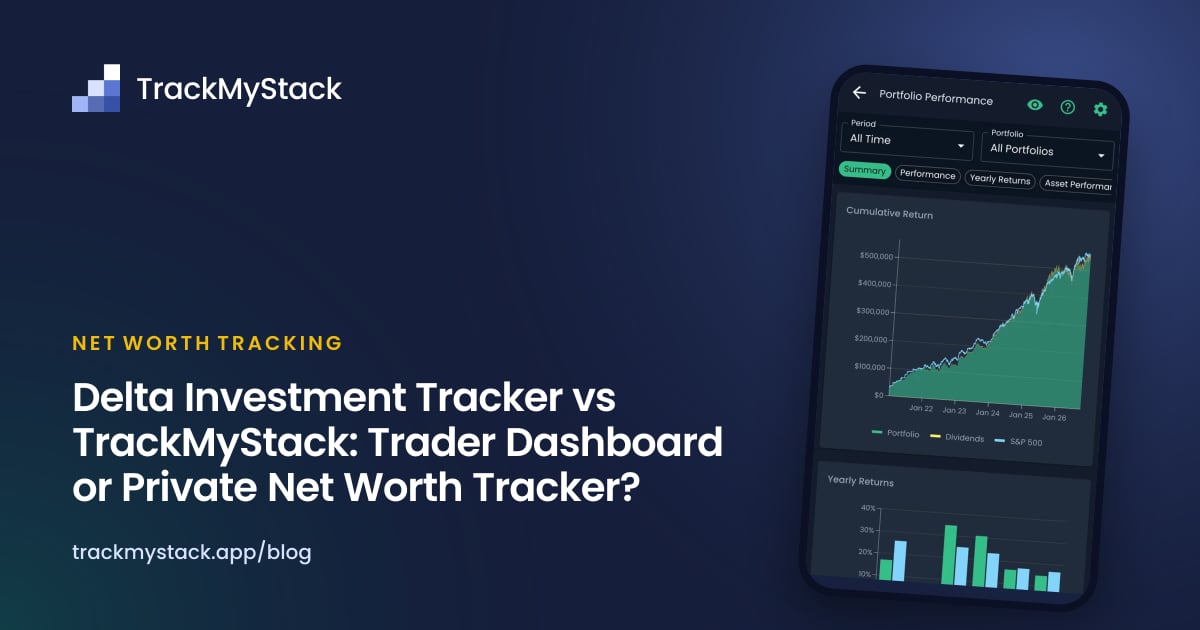
TrackMyStack’s Portfolio Performance page (Premium) is built around exactly that question. It takes every purchase, sale, dividend, and deposit you’ve ever made and computes XIRR — the same annualized-return calculation pension funds use — for both your portfolio and a benchmark of your choice. You can pick from 15 indices including S&P 500 Total Return, NASDAQ Total Return, MSCI All World, FTSE 100, DAX, Nifty 50, Nikkei 225, Bitcoin, and Gold. Set it once, and the whole page recalculates against that benchmark.
Then it goes asset by asset. For every position you’ve held in the period it shows: total purchases and sales, net capital flow, realized P&L, unrealized P&L, dividends, total P&L, what the same money would have done in the index — and the only column that really matters, difference vs index. Sort by it, and you see which of your picks were actually earning their place in your portfolio versus which ones you were keeping out of nostalgia.
There is also a yearly breakdown. Set the period to All Time and you get your portfolio’s annualized return next to the index’s, year by year. Most people who think they’re great investors had one good year in 2020 and have been quietly coasting on the memory ever since. The yearly chart will quietly correct that.
We are saying out loud what most portfolio trackers (Delta included) refuse to: tracking is the easy part. Evaluating is the part that changes behaviour. If your XIRR consistently trails an index fund’s XIRR over multiple years, the honest answer might be “buy an index fund and go to the beach,” and that’s a perfectly respectable conclusion.
This is also why TrackMyStack is built for the mid-to-long-term investor, not the day trader. The whole product nudges you toward looking at trends — yearly returns, vs-index columns, allocation drift, retirement timelines — instead of refreshing the same chart every fifteen minutes. Real-time prices exist on Premium for the days you genuinely need them, but they are not the centre of the product. The centre of the product is the question “is this still working?”
TrackMyStack: Pros and Cons
Pros:
- Free tier is genuinely useful — unlimited portfolios and assets, EOD prices, dividends, exports
- No account linking; no banking or exchange credentials shared with anyone
- No sign-up required; recovery email is optional
- Whole net worth view — investments, cash, property, debts in one place
- Multi-currency portfolios, with your total net worth shown in your home currency
- Portfolio Performance with XIRR and 15 benchmark indices — the answer to “am I actually beating the market?”
- iPhone, Android, and web apps, with home-screen widgets
- Premium is materially cheaper than Delta PRO ($53.88) or PRO+ ($107.88) at US prices
Cons:
- No automatic brokerage or exchange syncing — you enter transactions yourself (prices update automatically)
- No real-time push notifications on individual price moves; this is a deliberate design choice, not a roadmap item
- Asset analytics are portfolio-level (Vitals, vs-index, allocation), not single-stock insider-trade feeds
Delta vs TrackMyStack: Head-to-Head
| Delta | TrackMyStack | |
|---|---|---|
| Primary approach | Real-time investment dashboard with account linking | Private net worth tracker with manual entry and automatic price updates |
| Price | Free (10-asset cap) · PRO $53.88/yr · PRO+ $107.88/yr | Free (unlimited) · optional Premium (price varies by store and country) |
| Free tier | Capped at 10 assets, no real-time quotes | Yes, unlimited portfolios and assets, EOD prices |
| Trial | None on PRO/PRO+ (free tier only) | 1-week Premium trial |
| Account linking | Yes, brokerages, exchanges, wallets | No — manual entry, automatic prices |
| Asset coverage | Stocks, ETFs, crypto, commodities, indices, forex | Stocks, ETFs, crypto, real estate, cash, loans, bonds, custom assets |
| Multi-currency | Yes | Yes (each portfolio in its own currency) |
| Platforms | iOS, Android, Windows, Mac, Web | iOS, Android, Web |
| Complex structures | Multiple portfolios | Unlimited portfolios with tags, ownership %, include/exclude from net worth |
| Advisor sharing | No | No |
| Offline access | No | Read-only (your last synced data) |
| Privacy model | Account linking required for full value; owned by a brokerage (eToro) | No accounts linked, no name or email needed; data syncs securely between phone and web |
| Sign-up required | Yes | No |
| Benchmark vs index | Not a core feature | Yes — XIRR vs 15 benchmark indices, asset-by-asset and year-by-year |
| Whole net worth (assets + liabilities) | No, investments only | Yes |
Is TrackMyStack a Good Delta Alternative?
If “Delta alternative” to you means “another real-time trading dashboard with broker linking and insider-trade feeds,” then no — TrackMyStack is not trying to be that, and pretending otherwise would be dishonest.
If “Delta alternative” means “I started on Delta, but I want to see my whole net worth, not just my brokerage; I don’t want to hand over exchange API keys; and I’d like an actual answer on whether my picks are beating the index” — then yes. TrackMyStack is the best choice for mid-to-long-term investors who want a private, no-signup net worth tracker that judges performance against a benchmark, not just a wall of green and red numbers.
What’s the Best Net Worth Tracker for Long-Term Investors Who Don’t Want to Link Accounts?
For long-term investors who don’t trade frequently and don’t want to share brokerage or exchange credentials, the right tool is a manual-entry net worth tracker with automatic price updates and a serious benchmark comparison. TrackMyStack fits that profile directly: free unlimited portfolios, EOD prices on free, real-time prices and XIRR-vs-index analytics on Premium, and no account linking at any tier.
The Bottom Line
Delta and TrackMyStack are both good apps. They are just for different people.
Delta is built for active investors who want a real-time, multi-asset dashboard, who are comfortable connecting brokerage and exchange accounts, and who actually use the constant stream of prices, alerts, and insider-trade context. If you trade — properly trade — Delta earns its $53.88 or $107.88 a year.
TrackMyStack is built for the rest of us. Mid-to-long-term investors who want one private place to see their entire financial life, who’d rather understand the trend over years than the tick over seconds, and who’d like an honest answer to “is my stock picking actually working, or should I just buy the index?” The free tier alone covers most of what a long-term investor needs, Retirement Planner included; Premium adds the parts that actually change behaviour — real-time prices for the days you want them, XIRR vs 15 benchmark indices, and Portfolio Vitals.
A simple test: do you check your portfolio more than once a day? Delta. Do you check it once a week, once a month, or only when something interesting happens — and want to know whether your picks are beating the index over years? TrackMyStack. You’re welcome.
FAQ
Is Delta Investment Tracker free?
Delta has a free Basic tier capped at 10 tracked assets, with no real-time quotes and limited insights. Beyond that you need Delta PRO ($53.88/year) for up to 40 assets per portfolio, or Delta PRO+ ($107.88/year) for unlimited assets and the full set of analytics modules. Prices may vary by region.
Does TrackMyStack connect to my brokerage like Delta?
No. TrackMyStack does not connect to any brokerage, exchange, or crypto wallet. You enter holdings yourself, and TrackMyStack updates prices for supported stocks, ETFs, and crypto automatically. This is a deliberate design choice: no banking or exchange credentials are shared with TrackMyStack or any third-party aggregator, and there is no sign-up required to use the app.
Is Delta better for crypto or stocks?
Delta started as a crypto tracker and remains strong there, especially with API connections to exchanges and wallets. It also covers stocks, ETFs, commodities, indices, and forex. If your priority is real-time crypto tracking with auto-refreshing quotes and exchange linking, Delta has the edge. If your priority is seeing crypto inside your wider net worth — alongside stocks, cash, real estate, and liabilities — TrackMyStack is the better fit.
Can TrackMyStack tell me if I’m beating the S&P 500?
Yes. The Portfolio Performance page (TrackMyStack Premium) computes XIRR — the same annualized return calculation used in pension fund analysis — for both your portfolio and a benchmark index of your choice. You can pick from 15 indices including S&P 500 Total Return, NASDAQ Total Return, MSCI All World, FTSE 100, DAX, Nifty 50, Nikkei 225, Bitcoin, and Gold. The page also shows asset-by-asset and year-by-year comparisons against the chosen benchmark.
Is Delta owned by eToro?
Yes. Delta was acquired by eToro in 2019 and is now branded as “Delta by eToro.” Delta itself is not a brokerage and does not hold funds, but it is owned by one — worth knowing when evaluating an app that also surfaces investment recommendations and insights.
Which is cheaper, Delta or TrackMyStack?
TrackMyStack is cheaper at every comparable tier. TrackMyStack’s free plan offers unlimited portfolios and assets with end-of-day prices; Delta’s free plan caps at 10 assets and excludes real-time quotes. At US prices, TrackMyStack Premium costs less per year than Delta PRO ($53.88/year) or Delta PRO+ ($107.88/year), and it comes with a one-week free trial.
Is TrackMyStack a good Delta alternative for long-term investors?
Yes. TrackMyStack is designed for mid-to-long-term investors who want a private, no-signup view of their entire net worth (not just investments), with benchmark-aware performance analytics over months and years rather than real-time price tickers. Active day-traders who depend on real-time alerts and direct broker linking will be better served by Delta.